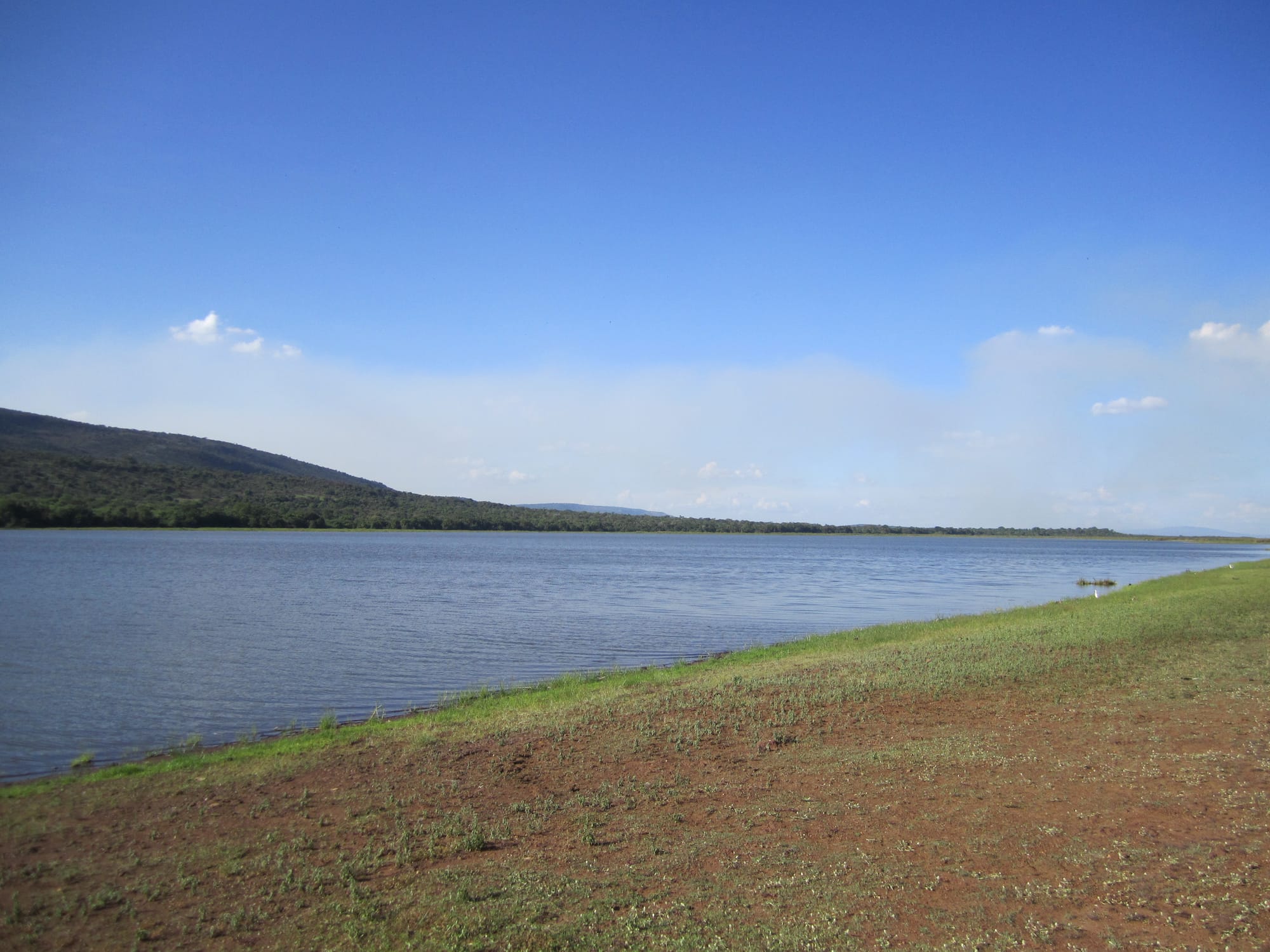
Akagera National Park occupies the far east of Rwanda, along the border with Tanzania, and it is unlike anywhere else in the country. Rwanda is famous for mountain gorillas and misty volcanoes; Akagera is hot, low, open savannah with lakes, papyrus swamps and a Big Five wildlife list.
It is also one of the most remarkable conservation recoveries in Africa. In 2010 the park had lost its lions and much of its wildlife to poaching and post-war resettlement. Fifteen years later it is fenced, professionally managed, fully stocked with Big Five species and covers the great majority of its own operating costs from tourism.
This guide covers everything you need to plan a visit: what the park is, how to get there, what it costs, when to go, how long to stay and how to fit it into a wider Rwanda itinerary.
What is Akagera National Park?
Akagera is Rwanda’s largest protected wetland and its only savannah park, covering about 1,122 square kilometres in the country’s Eastern Province. It was established in 1934, making it one of the oldest national parks in Africa, and it takes its name from the Akagera River, which flows along its eastern boundary and feeds a chain of ten lakes.
The landscape is layered. Along the river in the east are papyrus swamps and lakes — together the largest protected wetland in central Africa. West of these the land rises through acacia woodland and thicket into rolling grassland and, at the park’s western edge, a chain of hills reaching more than 1,800 metres. That variety is why a park this size holds around 12,000 large animals and close to 490 bird species.
The park was much larger before 1997, when a substantial portion was resettled for returning refugees after the genocide against the Tutsi. What remained was fenced along its western boundary in 2013, which ended the conflict between predators and neighbouring cattle farmers and made the reintroduction of lions possible.
The conservation story
Understanding what happened here makes the visit better. By the late 2000s Akagera was in a bad way: heavily poached, understaffed and with its last lions killed in the 1990s. In 2010 the Rwanda Development Board signed a joint management agreement with African Parks, a non-profit that takes on the day-to-day running of struggling protected areas.
What followed was systematic. A 120 km fence along the western boundary. A professionalised ranger force, a canine anti-poaching unit, helicopter surveillance and a community freephone line. Poaching fell sharply. With the park secure, the missing species could be brought back.
Seven lions arrived from South Africa in 2015. Eighteen eastern black rhinos followed in 2017, with five more from European zoos in 2019, and thirty southern white rhinos were translocated from South Africa in 2021 in one of the largest such operations ever attempted. Visitor numbers and tourism revenue have grown alongside, and a share of that revenue is reinvested in the communities around the park.
- Your park entry fee directly funds ranger salaries, anti-poaching work and community programmes.
- The park now generates the large majority of its own operating costs — visitors are the reason it works.
- Guides will ask you not to geotag rhino sightings. Please take that seriously.
How long do you need?
This is the question that most affects the quality of an Akagera trip, and the honest answer is that one day is enough to enjoy it and two days is enough to do it properly.
One day from Kigali
You leave Kigali around 5am, reach the gate by 8.30am, game drive the southern and central sectors, take the Lake Ihema boat safari and head back mid-afternoon. You will see giraffe, zebra, buffalo, hippo, crocodile, antelope and — with luck — elephant. You will probably not see lions, and you will not reach the northern plains.
Two days, one night
The transformative option. You cover the south on day one, sleep inside or beside the park, and are on the northern plains at first light on day two. Dawn is when predators are still active, and the north is where the lions and the biggest herds are. Two-day itineraries also let you add a night drive, which is the only way to see hyena, serval and genet.
Three days or more
Worth it for photographers, birders and anyone who wants to properly explore the north. Three days gives you two full dawn drives, a boat safari, a night drive and time to sit at sightings instead of rushing between them.
Suggested Rwanda itineraries
Akagera fits neatly into almost any Rwanda trip because it is close to Kigali and works as either a day trip or a two-night add-on.
4 days: Kigali & Akagera
- Day 1: Arrive Kigali, Genocide Memorial, overnight Kigali
- Day 2: Early transfer to Akagera, southern game drive, Lake Ihema boat safari, overnight in the park
- Day 3: Dawn game drive on the northern plains, afternoon return to Kigali
- Day 4: Kigali city tour and markets, depart
7 days: Gorillas & Big Five
- Day 1: Arrive Kigali
- Days 2–3: Volcanoes National Park — gorilla trek and golden monkeys
- Day 4: Transfer east to Akagera
- Days 5–6: Akagera game drives, boat safari and a night drive
- Day 7: Return to Kigali and depart
10 days: the full country
- Days 1–2: Kigali
- Days 3–4: Volcanoes National Park — gorillas
- Days 5–6: Lake Kivu
- Days 7–8: Nyungwe Forest — chimpanzees and the canopy walkway
- Days 9–10: Akagera — Big Five safari and Lake Ihema
What it costs
Akagera is a mid-to-high-priced park by African standards, mostly because of the daily entry fee. Budget realistically and check the current official rates before you commit.
- Park entry: around US$100 per non-resident international visitor per day, with substantial discounts for East African residents and Rwandan nationals
- Lake Ihema boat safari: roughly US$45–55 per person for a scheduled trip
- Night game drive: around US$50 per person
- Park guide: roughly US$40 per day per vehicle
- Organised day trip from Kigali: US$180–400 per person
- Two-day safari with accommodation: US$490–900 per person
- Accommodation: US$30 per person camping to US$800+ per night at the luxury camps
- Are park entry fees included in the tour price, or paid separately at the gate?
- Is the Lake Ihema boat safari included, or an add-on?
- What is the cancellation window, and is it free?
Practical information
Money
- The Rwandan franc (RWF) is the local currency; US dollars are widely accepted for park fees and tours
- Cards work at park reception, lodges and better restaurants, but carry cash as a backup
- ATMs are plentiful in Kigali and scarce near the park — withdraw before you leave the capital
- Tipping is not obligatory but is appreciated; US$10–20 per day for a guide is a common benchmark
Connectivity & power
- Local SIM cards from MTN or Airtel are cheap and easy to buy in Kigali with a passport
- Coverage inside the park is patchy in the south and largely absent in the north
- Rwanda uses type C, J and F plugs at 230V — bring a European-style adapter
- Campsites have no power; bring a power bank
Language & etiquette
- Kinyarwanda is the national language; English and French are both widely used, and English is the language of tourism
- Always ask before photographing people
- Do not photograph government or military installations
- Plastic bags are illegal nationwide — repack before you fly
Visiting responsibly
Akagera exists today because tourism pays for it. A few simple habits make your visit better for the park, the wildlife and the people who live alongside it.
- Stay on the tracks. Off-road driving damages the grassland and is prohibited.
- Keep a respectful distance from animals and never ask a guide to get closer than they are comfortable with.
- Do not geotag or publicly share rhino locations.
- Take all waste out with you, especially from the campsites.
- Buy from local craft cooperatives and community enterprises around Kayonza rather than only from lodge shops.
- Never feed animals — the baboons around the campsites are already too confident.